Before the drone was a drone, it was a sound.
The first evidence of drone music came in the form of a bullroarer, 20,000 years ago. In the depths of an ice age, a flat stone tied to a cord emitted a deep hum when spun in circles, loud enough to travel across glaciers. The sound may have provided an invitation to ritual, or a warning—the drone’s resonance will be difficult to pin down for a few more eons. In the late Medieval period, the drone sounds again, waiting beneath the slow sounds of the dirge, a genre of mournful music performed at funerals. Here, the sounds of the drone serve to transport the listener outside of their body, where they might attune themselves more closely to the will of God. The dirge is named for a Latin liturgy for the dead, which begins “dirige, domino, deus emus”—“Direct my way in your kingdom, God” [1]. In the hum of the drone, the mourner asks to surrender their body to a divine operator.
*
Drone pilots bask under the radio-blue hum of screens. The Beale Air Force Base is a sprawl of squat white buildings, nestled in the foothills of Northern California. Here, operators shift in and out of their stations like clockwork. Today, their screens are filled with simulated war fields for the benefit of a camera crew filming recruitment videos. When the cameras disperse, the servers will come back online, creating portals to elsewhere: Afghanistan, Pakistan, Somalia, Yemen. The battlefield stretches out along wires and pours down from satellites. An olive-clad pilot ducks out from his station, and a new operator slips into his place. The patch on his sleeve is a three-pronged wheel, framing a pair of yellow eyes. Block letters call out his squadron motto: WE HAVE THE WATCH.
*
A drone looks down over the West Bank. Aerial footage has a way of flattening the hills, orienting the landscape and its inhabitants into a neat grid of zones of conflict. The Northrop Global Hawk, freed from the constraints of a pilot’s body, can hang in the atmosphere for 30 hours at a time, producing silver-and-black thermal images. Bodies show up as sparks of light. Densely populated places glow brighter. The Global Hawk, roughly the size of a blue whale, waits at a high altitude. It will not descend for combat, nor for a closer look. Veiled by the thickness of the air, the drone appears from the ground to be a smudge, a void, or nothing at all.
*
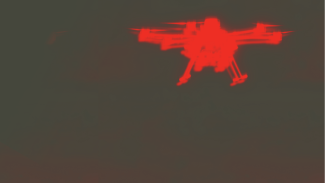
It is the smaller drones that crowd the bright places. They are heard before they are seen. They move like spiders, tracing invisible lines, floating through open windows. If the Global Hawk flattens the landscape, quadrocopters like the Evo Autel burrow into it, penetrating walls, windows, and homes. The Evo Autel is a commercial drone, originally marketed to professional photographers and presently retrofitted by the Israeli military to carry explosives into close quarters [2]. In July, Palestinian refugees hailing from Rafah, Khan Younis, and Gaza City reported that the commercial drones were being used to enforce genocidal expulsion orders, killing friends and family members who attempted to return to their homes. An Israeli officer spoke to one media outlet on the outskirts of Khan Younis, half-watching a drone feed of a residential street. “Whoever they spot, they kill,” he explained [3]. This is a story about seeing as violence.
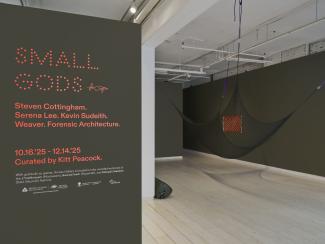
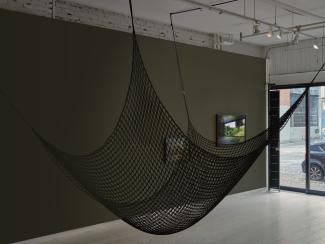
In Small Gods: Perspectives on the Drone, cultural theorist Alex Quicho fragments the figure of the drone, tracing its representations as “soothing sound, aerial spy, and killing machine” [4]. Following in the wake of Quicho’s work, the exhibition seeks to identify a resistant figure in the drone through a horizontal network of visual practice. What do we stand to gain by returning the drone’s gaze?
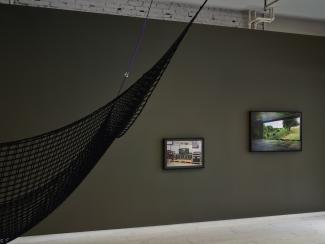
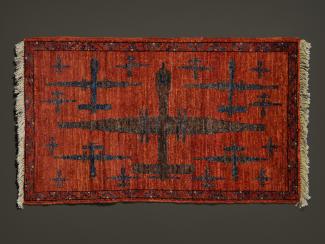
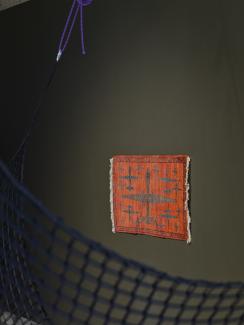
Brown Predator Drones on Rust Red Field War Rug (2015), by the Weaver and Kevin Sudeith, rewrites the visual hierarchy associated with the influx of military drones in American-occupied Afghanistan. With the outlines of bottom-mounted engines visible on each wing, the drones are indeterminate: either glimpsed in tense flight by a viewer on the ground, or seen from above as they lay belly-up on the earth.
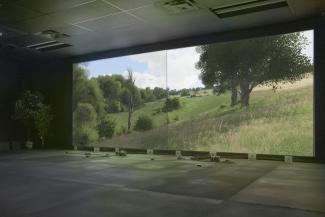
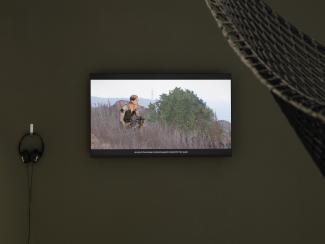
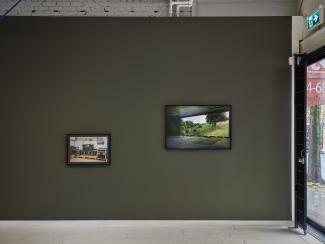
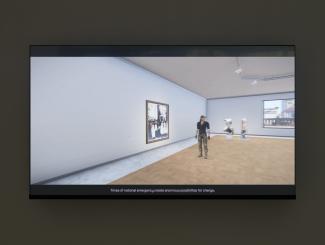
Works by Steven Cottingham load in and out of simulated military worlds, from Canadian Armed Forces training ranges in Petawawa, Ontario, to the open world military simulation game Arma 3. In As far as the drone can see (2023), an insurgent group rebels against the simulation, examining the gendered figure of the drone as a mindless labourer in times of war. ground cloud (2025) and virtual range (2025) project our presence behind the curtain of a military base, as if we have awoken, for a moment, from the simulation.
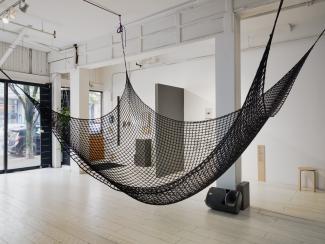
Serena Lee’s That which is continuous (2025) works through suspension. The sound of a guqin—a Chinese zither with a history dating back three thousand years—veers between soothing and dissonant. The track is permeated by voids and sliding spells, where the listener trips back into themself, caught in a meditative return.
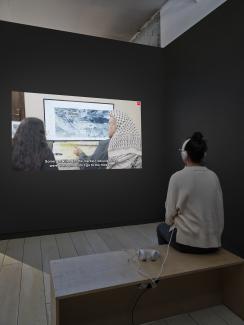
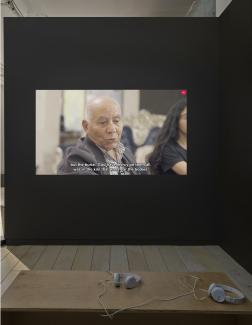
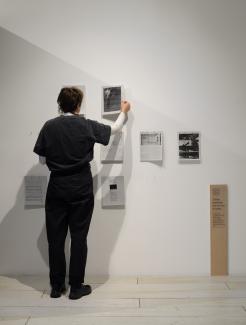
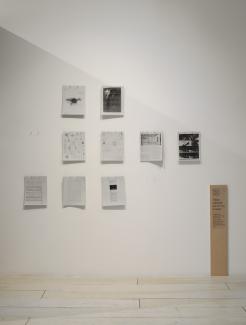
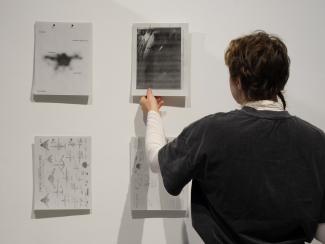
In The Massacre at Tur al-Zagh: Al-Dawayima, 29 October 1948 (2025), Forensic Architecture redeploys the aerial visuality of the drone as a tool for resistance, matching aerial photographs with situated testimonies from survivors of the 1948 ethnic cleansing of al-Dawayima, a farming village in Palestine’s Hebron district. The resulting three-dimensional models assemble survivors’ memories into public, legally-admissible evidence of the genocide which continues today.
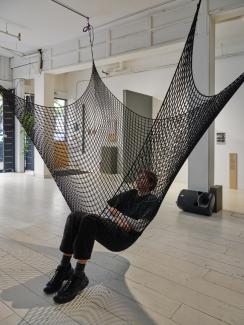
Through ancestral practice, inversion, and resistant technology, Small Gods envisions the drone-in-transmutation: as violent machine and resident of our speculative future.
*
1. Alex Quicho, Small Gods: Perspectives on the Drone (London: Zero Books, 2021), chp. 01.
2. Yuval Abraham, “‘Like a video game’: Israel enforcing Gaza evacuations with grenade-firing drones,” +972 Magazine, July 10 2025.
3. Ibid.
4. Alex Quicho, Small Gods: Perspectives on the Drone (London: Zero Books, 2021), preface.